August 4, 2026
Why Cannabis Turns Purple


Purple sells. Walk any dispensary counter in Washington and the violet jars move first. Whether a given plant can turn purple at all is settled by its genetics before you touch a thermostat, and what it costs to push the ones that can is settled by temperature and by bud rot.
Start here: can the cultivar even do it?
Genetics gates the whole thing. If a cultivar Cultivar A specific cultivated variety maintained by propagation. It is the precise term for what is loosely called a "strain". does not carry functional anthocyanin Anthocyanin Water-soluble flavonoid pigments stored in plant cell vacuoles. They produce purple, red and blue tones in cannabis and in many fruits and vegetables. biosynthesis genes and the regulatory MYB MYB transcription factor A member of a large family of DNA-binding regulatory proteins. Different plant MYB proteins control processes including development, stress responses, and flavonoid production. alleles Allele An alternative DNA sequence found at a particular position in the genome. In a diploid cannabis plant, the two copies at that position may carry the same or different alleles. to switch them on, no amount of cold will turn it purple. You will just cold-stress a green plant.
| Category | What you see | Does a cool finish help? | What to do |
|---|---|---|---|
| Constitutive purple | Purple in veg and in flower, whatever the climate | No, the color is already maxed | Nothing. Run your normal climate and keep the yield |
| Inducible purple | Green baseline, colors under cool conditions or in late flower | Yes, and this is the only category where it matters | The rest of this page applies to you |
| Non-anthocyanin | Stays green | No | Chasing color here only causes damage |
Which bucket each cultivar falls into is a phenohunting Phenohunting Growing out a seed population and selecting the individual plants worth keeping. It is how a breeder finds the one phenotype that becomes a named cultivar. question, not a climate question. Work in Chinese cabbage (Kim et al., 2022) shows the gate cleanly: purple-leaf seedlings accumulated high anthocyanin under every condition tested (39 °F / 4 °C and 75 °F / 24 °C, with and without sucrose), while green-leaf seedlings stayed green even at 39 °F (4 °C), because they carried a functional repressor protein that shut down MBW complex MBW complex A regulatory protein complex formed by MYB, bHLH, and WD40 proteins. In flowering plants, MBW complexes control the expression of genes in several flavonoid pathways. activity. Genotype Genotype The genetic makeup an organism carries, as distinct from the phenotype (the observable traits that result from a genotype interacting with its environment). gated the response entirely.
Why it happens: anthocyanins, not cannabinoids
The purple, red, blue and near-black tones come from anthocyanins, the water-soluble flavonoid Flavonoid A large class of plant compounds covering pigments, UV protectants and antioxidants, found throughout the plant kingdom. Anthocyanins are one flavonoid subclass. pigments stored in the vacuoles Vacuole The large fluid-filled compartment inside a plant cell, used for storage and to maintain turgor pressure. Water-soluble pigments such as anthocyanins are held here. of plant cells. They are the same class of molecule that colors blueberries, red cabbage and Concord grapes.
Bassolino et al. (2023) were the first to identify the dominant anthocyanin in Cannabis sativa as cyanidin-3-rutinoside, also called keracyanin, in stems, leaves and floral tissue. Keracyanin concentrations in some pigmented tissue exceeded levels found in small berries, so purple cannabis biomass is a legitimately dense source of these antioxidants.
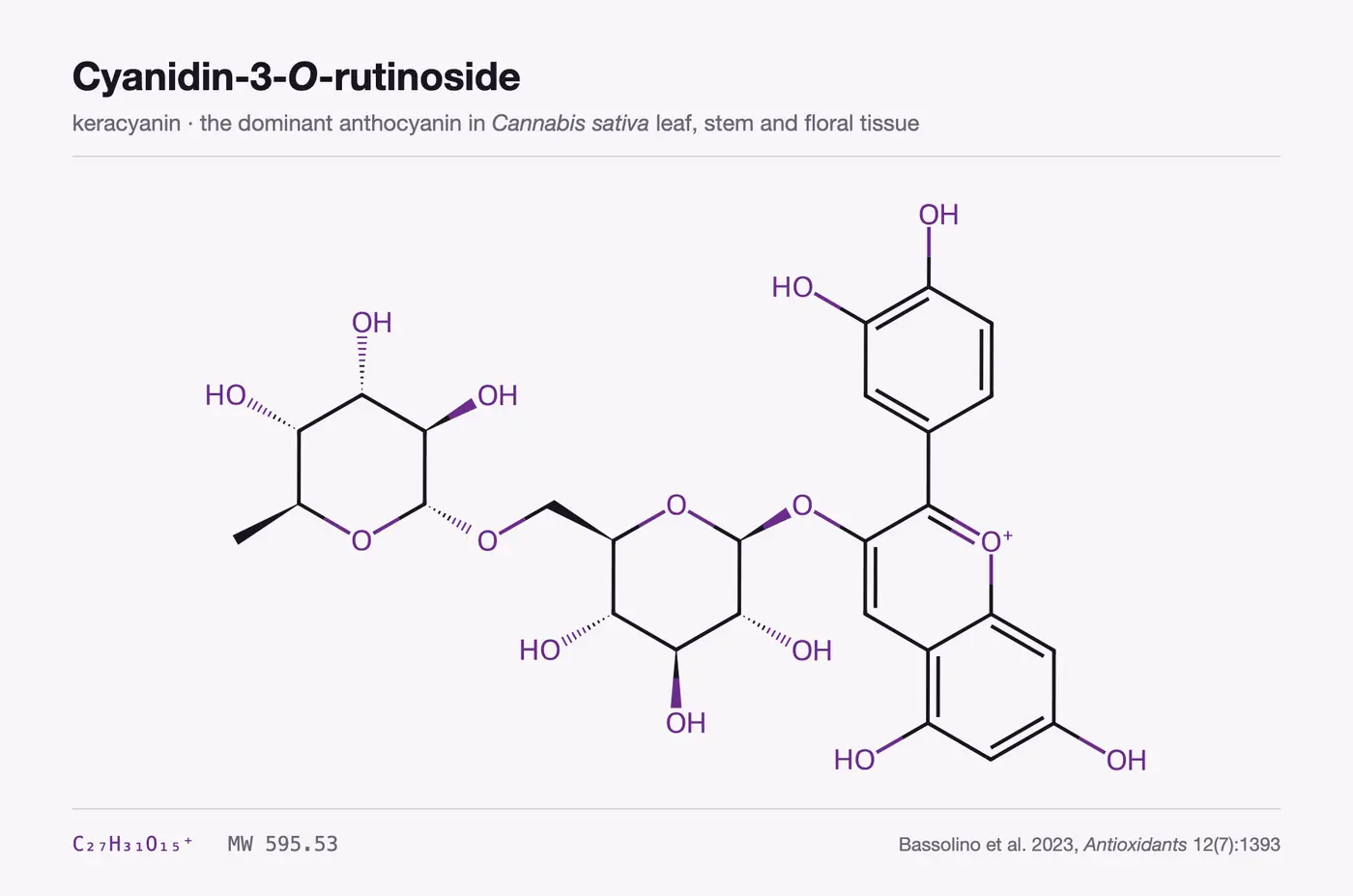
Anthocyanins are built through the flavonoid branch of the phenylpropanoid pathway Phenylpropanoid pathway A branching network of plant metabolism that begins with phenylalanine and produces compounds including lignin and flavonoids. Anthocyanins arise from one flavonoid branch. . Gagalova et al. (2024) profiled four differently pigmented cannabis varieties and found the genes 4CL, CHS, F3H, F3′H, FLS, DFR, ANS and OMT most strongly correlated with anthocyanin accumulation in leaves. Regulation runs through the MBW complex, a MYB / bHLH / WD40 transcription factor Transcription factor A protein that binds specific DNA sequences and influences whether nearby genes are transcribed into RNA. A transcription factor can activate or repress its targets. partnership, with CsMYB82 and CsMYB87 implicated as master regulators in cannabis.
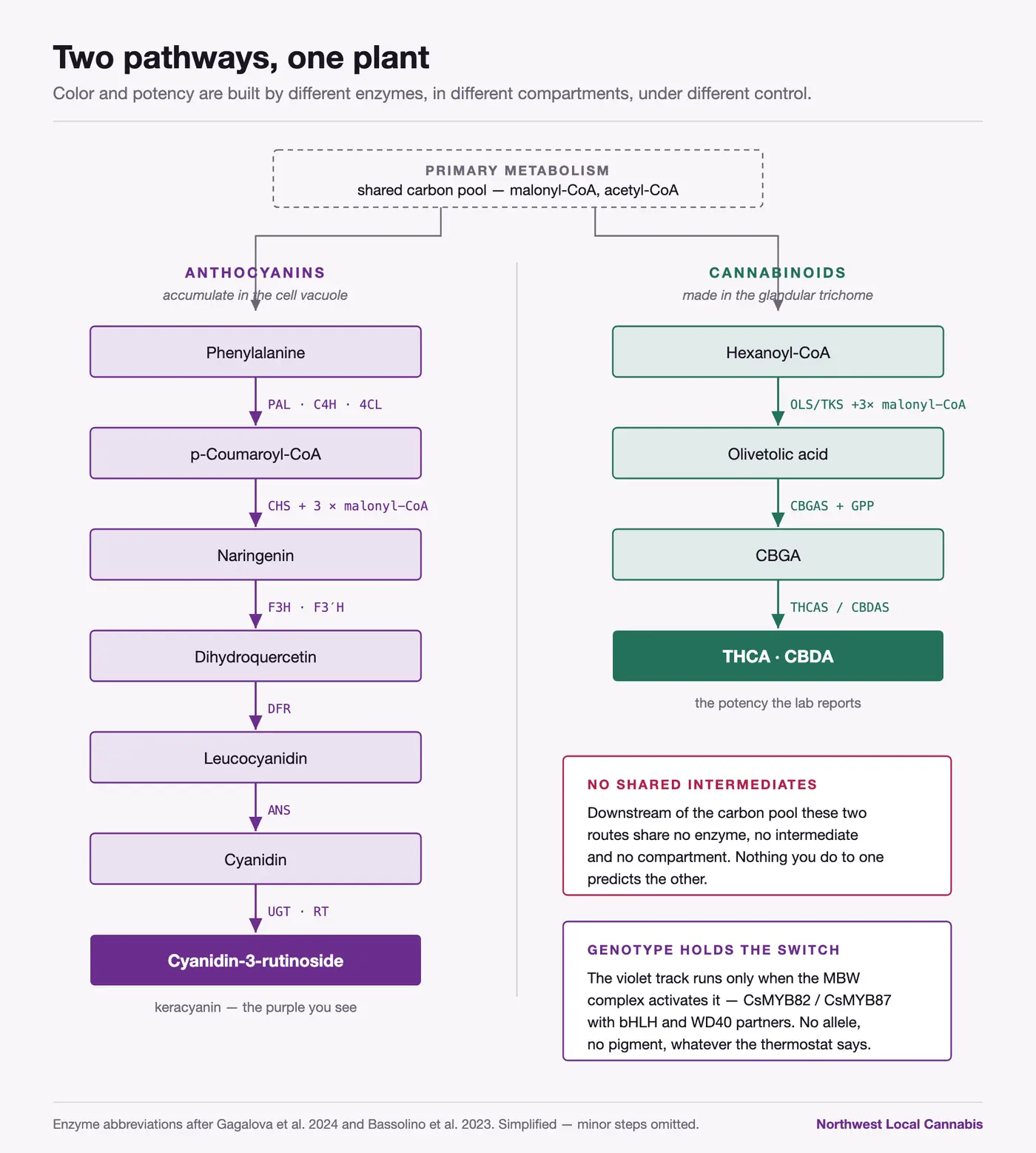
The structural point that settles the potency question: cannabinoids Cannabinoid A member of a chemically related group of compounds found in cannabis, including THC, CBD and CBG, that can interact with biological targets in different ways. are synthesized in the glandular trichomes Trichome A hairlike structure on a plant surface. In cannabis, glandular trichomes on female flowers synthesize and store cannabinoids, terpenes and other metabolites. via a completely separate pathway (polyketide to CBGA to THCA and CBDA). Anthocyanins are synthesized in the vacuoles of the underlying tissue. The two systems do not feed each other. A purple cola and a high-THC cola have nothing in common downstream of the shared carbon pool.
What temperature actually does, and what it costs
The most directly relevant study is Kim, Basnet, Kovaleski and Ellison (2025) in the Journal of Cannabis Research. They used a day-neutral inbred population with uniform purple expression and tested constant temperatures from 33 °F to 72 °F (0.5 °C to 22 °C), measuring inflorescence Inflorescence The botanical term for a flower cluster, what the trade calls a bud. Research reports cannabis yield as inflorescence dry weight. dry weight, CBD percentage and anthocyanin concentration.
| Measure | As temperature rises | Where it peaks |
|---|---|---|
| Anthocyanin accumulation | Falls | 46 °F and 59 °F (8 °C and 15 °C) |
| Inflorescence dry weight | Rises | Top of the tested range, 72 °F (22 °C) |
| Total CBD | Rises | Top of the tested range, 72 °F (22 °C) |
The authors attribute the dry weight and CBD gains largely to plant maturity rather than to a direct temperature stimulus, and they note that metabolic processes persisted even at 39 °F (4 °C), which puts the base temperature for cannabis lower than previously documented. Their operative conclusion: higher temperatures promote dry weight and CBD, and may also suppress anthocyanin production.
For context on the other end, general optimal growth temperatures for cannabis have been proposed at 77 to 86 °F (25 to 30 °C) (Chandra et al., 2008), varying by genotype and developmental stage. Above roughly 86 °F (30 °C) that same work reports stomatal conductance Stomatal conductance A measure of how readily carbon dioxide and water vapor pass through a leaf's stomata, reflecting pore opening and the gas-exchange capacity of the leaf surface. and net photosynthesis Net photosynthesis The rate at which a leaf gains carbon through photosynthesis after subtracting carbon released by respiration and photorespiration. beginning to suffer.
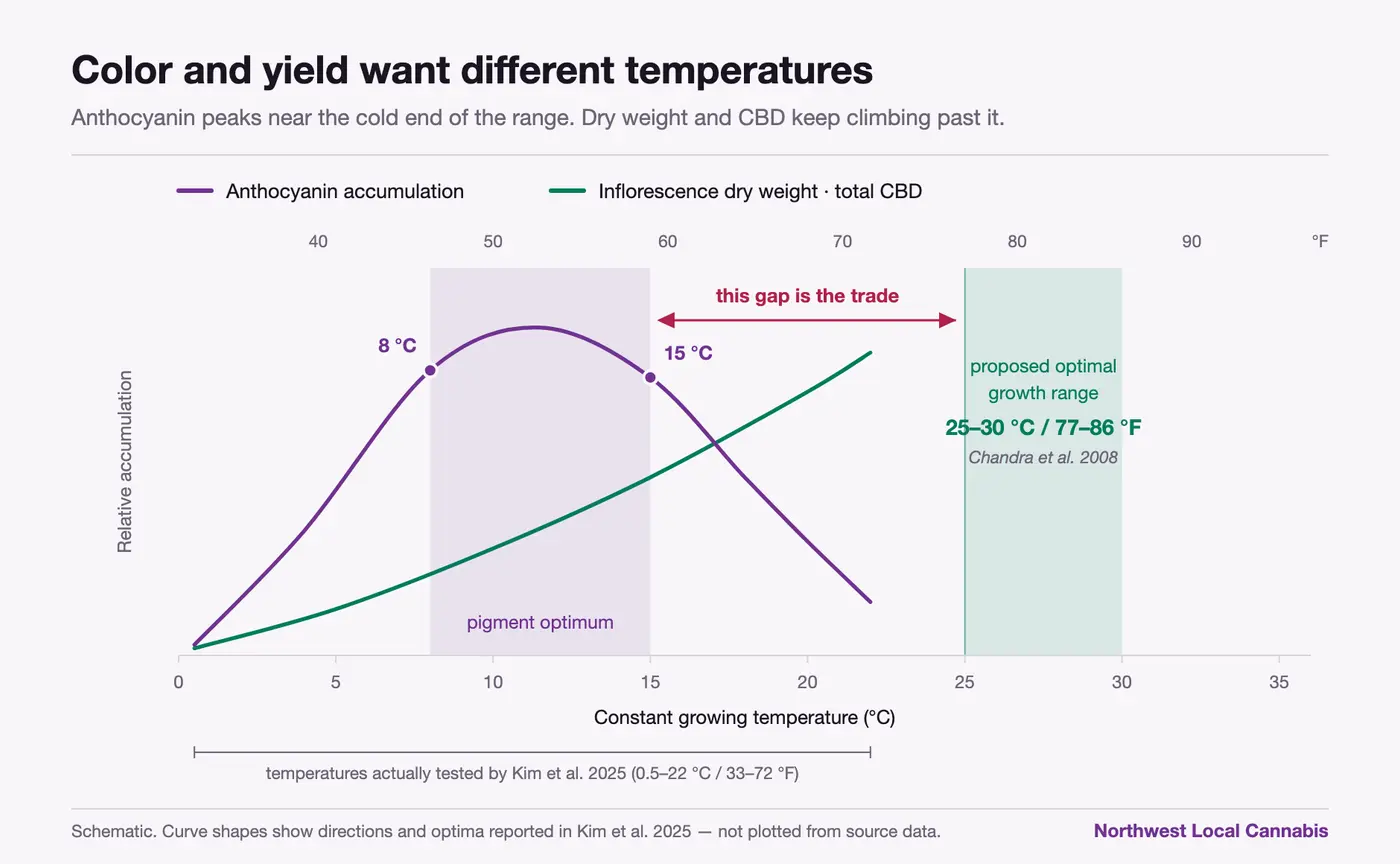
Read those two ranges together. The temperature that maximizes color sits well below the temperature that maximizes growth. You are trading yield for pigment. Not necessarily a bad trade, since bag appeal Bag appeal The visual and aromatic impression of cannabis flower before it is used or tested, including color, trichome coverage, structure, trim, and aroma. has real market value, but it should be a deliberate, quantified decision rather than an accident.
The chlorophyll unmasking effect
A large share of the purpling you see in weeks 7 to 9 is not new pigment at all. It is chlorophyll degradation revealing anthocyanins that were already there.
Chlorophyll Chlorophyll The green pigment that captures light for photosynthesis. It dominates the color of healthy plant tissue and breaks down as a plant senesces. is a dominant green pigment that visually overwhelms anthocyanins underneath it. As a plant moves into senescence Senescence The natural winding-down at the end of a plant's life cycle, when nitrogen moves out of the leaves and chlorophyll breaks down. , with nitrogen remobilizing out of the leaves and the plant winding down, chlorophyll breaks down and the underlying color surfaces. This is why purpling shows up so reliably in late flower, and why growers credit the temperature drop they happened to make at the same time. Both processes run on the same clock.
The bud rot problem
A cool finish is a disease bet, not just a yield cost, because the window that moves pigment is the same window that grows bud rot. The infections that matter establish at flower days 14 to 28, weeks before any symptom shows (Buirs, Lung and Punja, 2025), so a room that survives one cold week clean tells you nothing about the finish.
Day and Night Temp Setpoints
Whether a room can turn purple at all was settled in the phenohunt, and that decision is most of the outcome. What climate can add is smaller and slower: a 5 to 10 °F (3 to 6 °C) DIF DIF Day temperature minus night temperature. DIF can influence stem elongation, but the direction and size of the response vary with species, cultivar, timing, and conditions. in late flower is within normal practice, and it does most of what cold can do.
| Stage | Day temp | Night temp | DIF |
|---|---|---|---|
| Veg | 78 °F (26 °C) | 72 °F (22 °C) | 6 °F (3 °C) |
| Transition and stretch | 82 °F (28 °C) | 74 °F (23 °C) | 8 °F (4 °C) |
| Flower, week 3 to the taper | 82 °F (28 °C) | 76 °F (24 °C) | 6 °F (3 °C) |
| Taper, day 10 | 81 °F (27 °C) | 73 °F (23 °C) | 8 °F (4 °C) |
| Taper, day 9 | 80 °F (27 °C) | 72 °F (22 °C) | 8 °F (4 °C) |
| Taper, day 8 | 79 °F (26 °C) | 71 °F (22 °C) | 8 °F (4 °C) |
| Taper, day 7 | 78 °F (26 °C) | 70 °F (21 °C) | 8 °F (4 °C) |
| Taper, day 6 | 77 °F (25 °C) | 69 °F (21 °C) | 8 °F (4 °C) |
| Taper, day 5 | 76 °F (24 °C) | 68 °F (20 °C) | 8 °F (4 °C) |
| Taper, day 4 | 75 °F (24 °C) | 66 °F (19 °C) | 9 °F (5 °C) |
| Taper, day 3 | 74 °F (23 °C) | 65 °F (18 °C) | 9 °F (5 °C) |
| Taper, day 2 | 73 °F (23 °C) | 63 °F (17 °C) | 10 °F (6 °C) |
| Taper, day 1 | 73 °F (23 °C) | 63 °F (17 °C) | 10 °F (6 °C) |
| Taper, day 0 | 73 °F (23 °C) | 63 °F (17 °C) | 10 °F (6 °C) |
Night setpoints are the same in both rooms, and they have to be: nothing is fixed in the dark, so the night climate answers to the disease ceiling either way. Only the day side belongs to CO₂. Without injection there is no reason to hold the canopy at 82 °F (28 °C), so the unenriched room stays at its 76 to 78 °F (24 to 26 °C) day band and the full differential arrives late, almost entirely from the night side.
| Stage | Day temp | Night temp | DIF |
|---|---|---|---|
| Veg | 76 °F (24 °C) | 72 °F (22 °C) | 4 °F (2 °C) |
| Transition and stretch | 78 °F (26 °C) | 74 °F (23 °C) | 4 °F (2 °C) |
| Flower, week 3 to the taper | 78 °F (26 °C) | 76 °F (24 °C) | 2 °F (1 °C) |
| Taper, day 10 | 78 °F (26 °C) | 73 °F (23 °C) | 5 °F (3 °C) |
| Taper, day 9 | 78 °F (26 °C) | 72 °F (22 °C) | 6 °F (3 °C) |
| Taper, day 8 | 78 °F (26 °C) | 71 °F (22 °C) | 7 °F (4 °C) |
| Taper, day 7 | 78 °F (26 °C) | 70 °F (21 °C) | 8 °F (4 °C) |
| Taper, day 6 | 77 °F (25 °C) | 69 °F (21 °C) | 8 °F (4 °C) |
| Taper, day 5 | 76 °F (24 °C) | 68 °F (20 °C) | 8 °F (4 °C) |
| Taper, day 4 | 75 °F (24 °C) | 66 °F (19 °C) | 9 °F (5 °C) |
| Taper, day 3 | 74 °F (23 °C) | 65 °F (18 °C) | 9 °F (5 °C) |
| Taper, day 2 | 73 °F (23 °C) | 63 °F (17 °C) | 10 °F (6 °C) |
| Taper, day 1 | 73 °F (23 °C) | 63 °F (17 °C) | 10 °F (6 °C) |
| Taper, day 0 | 73 °F (23 °C) | 63 °F (17 °C) | 10 °F (6 °C) |
Three myths worth retiring
| The claim | What is actually true |
|---|---|
| Purple means more potent | No mechanistic basis and no evidence. Separate pathways, separate tissues, separate regulation. Trichome density is a better visual proxy, and lab results are the only real answer. |
| You can control color with feed pH | Anthocyanin color is genuinely pH-dependent, but the pH that matters is vacuolar pH inside the cell, which is homeostatically regulated and genetically set. Your reservoir does not steer it, and running off-target costs nutrient availability long before it changes a shade. |
| Shock them cold in the last two weeks | Induction is a gradual acclimation response, so an abrupt drop is a stress event rather than a finishing technique. It buys stalled ripening, reduced translocation, and the conditions pathogens are waiting for. |
Two of those carry an operational cost worth naming on its own. Running the reservoir off-target to chase color creates lockout Lockout A cultivation term for impaired nutrient uptake even though nutrients are present, often associated with unsuitable pH, excess salts or root stress. problems fast in coco drain-to-waste, long before it moves a shade. And an abrupt late chill cuts translocation Translocation The movement of sugars and nutrients through a plant's phloem, from where they are made or stored to where they are needed. at exactly the point the plant is still moving resources into flower.
References
- Bassolino, L., Fulvio, F., Pastore, C., Pasini, F., Gallina Toschi, T., Filippetti, I., & Paris, R. (2023). When Cannabis sativa L. turns purple: Biosynthesis and accumulation of anthocyanins. Antioxidants, 12(7), 1393. https://doi.org/10.3390/antiox12071393
- Buirs, L., Lung, S., & Punja, Z. K. (2025). The epidemiology and management of Botrytis cinerea causing bud rot on greenhouse cultivated cannabis (Cannabis sativa L.). Canadian Journal of Plant Pathology, 47(5), 443–463. https://doi.org/10.1080/07060661.2025.2478250
- Chandra, S., Lata, H., Khan, I. A., & ElSohly, M. A. (2008). Photosynthetic response of Cannabis sativa to variations in photosynthetic photon flux densities, temperature and CO₂ conditions. Physiology and Molecular Biology of Plants, 14(4), 299–306. https://doi.org/10.1007/s12298-008-0027-x
- Gagalova, K., et al. (2024). Leaf pigmentation in Cannabis sativa: Characterization of anthocyanin biosynthesis in colorful Cannabis varieties. Plant Direct, 8(11), e70016. https://doi.org/10.1002/pld3.70016
- Kim, J., Kim, D.-H., Lee, J.-Y., & Lim, S.-H. (2022). The R3-type MYB transcription factor BrMYBL2.1 negatively regulates anthocyanin biosynthesis in Chinese cabbage (Brassica rapa L.) by repressing MYB–bHLH–WD40 complex activity. International Journal of Molecular Sciences, 23(6), 3382. https://doi.org/10.3390/ijms23063382
- Kim, S. R., Basnet, P., Kovaleski, A. P., & Ellison, S. L. (2025). Anthocyanin accumulation, inflorescence dry weight and total cannabidiol content have different temperature optima in Cannabis sativa. Journal of Cannabis Research, 7, 51. https://doi.org/10.1186/s42238-025-00311-w
Northwest Local Cannabis publishes cultivation science for licensed producers and home growers. Nothing here is a product claim: potency and quality are determined by lab testing, not appearance.
Northwest Local Cannabis nw-local.com/blog/why-cannabis-turns-purple