August 27, 2026
VPD by Day, Dew Point by Night


You can run a humidity number that looks safe all night and still find a dense cola browning from the inside. The meter is not broken. It reads the air, and water does not condense in the air. It condenses on the coldest surface in the room: an outside wall, the concrete floor, or the outer buds in a dead corner the fans do not reach. When that surface is colder than the dew point, water forms on it while the gauge still reads 59 percent. This is exactly what causes botrytis Botrytis cinerea The fungus behind bud rot, also called gray mold. Its spores germinate in prolonged leaf wetness at high humidity, at roughly 55 to 75 °F (13 to 24 °C). (aka bud rot).
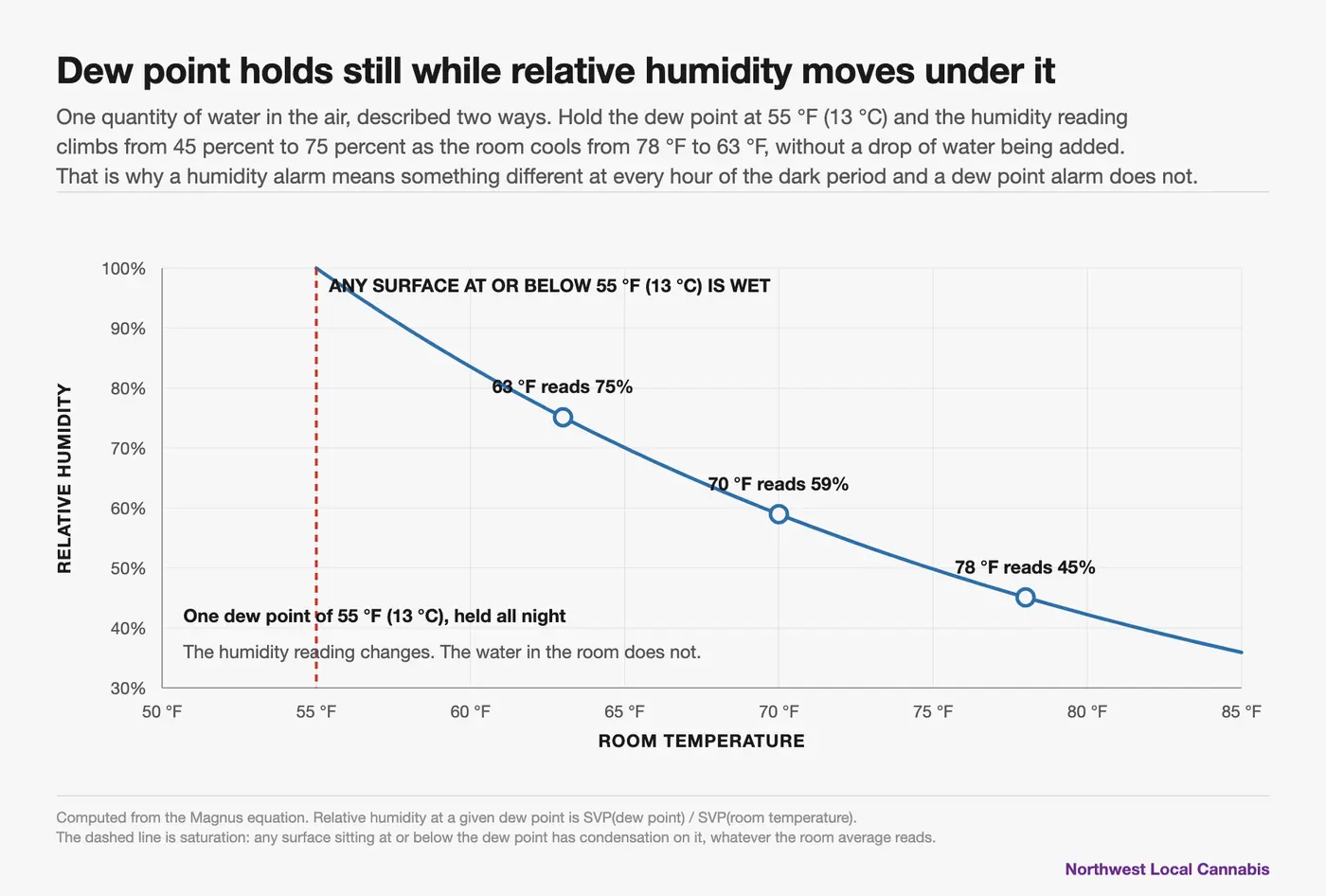
Dew point Dew point The temperature at which air with its current water-vapor content reaches saturation. Cooling a surface to or below the dew point can produce condensation. is the temperature at which water starts to condense, so it measures how much water is in the air directly. Relative humidity Relative humidity The share of moisture air is holding against the most it could hold at that temperature. Because it moves with temperature, cooling air raises RH with no water added. does not. It is a percentage of what the air could hold at its current temperature, so the reading changes when the temperature changes even though no water was added. Cool the room and the dew point stays the same while the humidity reading goes up. That is what makes dew point the number to watch at night: it tells you how cold a surface can get before water forms on it.
The check is one subtraction. Take the coldest surface you can measure and subtract the dew point. A positive result means the surface is warmer than the dew point and stays dry. A negative result means the surface is at or below the dew point and water is forming on it. The humidity reading cannot give you this, because it never measures the surface. This calculator does the subtraction for you: enter what your meter reads and your coldest surface, and it tells you whether that surface is condensing.
Setpoints by stage
Here is the schedule we run: a sealed room with supplemental CO₂ and a cool finish for color. It holds the night dew point a fixed 15 °F (8 °C) under the room temperature, which is where that margin comes from. The taper rows count down to harvest day.
The day column is aimed at transpiration Transpiration Water moving up through the plant and evaporating out through the stomata. It drives nutrient uptake, and carries calcium, which moves almost entirely by that flow. . VPD is the pull that draws water up the xylem Xylem The vascular tissue that carries water and dissolved minerals from root to leaf. Flow is one way and pulled by transpiration, so anything that slows transpiration slows delivery. , and that water carries calcium into the shoot tips, so the day figures are a growth input rather than a disease guard.
| Stage | Canopy temperature | Relative humidity | Leaf VPD (kPa) | CO₂ target (ppm) |
|---|---|---|---|---|
| Clone and propagation | 75 °F (24 °C) | 79% | 0.60 | 420 |
| Veg | 78 °F (26 °C) | 66% | 1.10 | 1,000 |
| Transition and stretch | 82 °F (28 °C) | 65% | 1.30 | 1,000 |
| Flower, week 3 to the taper | 82 °F (28 °C) | 62% | 1.40 | 1,200 |
| Taper, day 10 | 81 °F (27 °C) | 61% | 1.40 | 1,000 |
| Taper, day 9 | 80 °F (27 °C) | 60% | 1.38 | 1,000 |
| Taper, day 8 | 79 °F (26 °C) | 60% | 1.35 | 800 |
| Taper, day 7 | 78 °F (26 °C) | 59% | 1.33 | 800 |
| Taper, day 6 | 77 °F (25 °C) | 58% | 1.30 | 650 |
| Taper, day 5 | 76 °F (24 °C) | 58% | 1.28 | 650 |
| Taper, day 4 | 75 °F (24 °C) | 57% | 1.25 | 500 |
| Taper, day 3 | 74 °F (23 °C) | 57% | 1.23 | 500 |
| Taper, days 2 to 0 | 73 °F (23 °C) | 56% | 1.20 | 420 |
| Stage | Night temperature | Dew point setpoint | Implied humidity |
|---|---|---|---|
| Clone and propagation | 73 °F (23 °C) | N/A | N/A |
| Veg | 72 °F (22 °C) | 57 °F (14 °C) | 59% |
| Transition and stretch | 74 °F (23 °C) | 59 °F (15 °C) | 59% |
| Flower, week 3 to the taper | 76 °F (24 °C) | 61 °F (16 °C) | 59% |
| Taper, day 10 | 73 °F (23 °C) | 58 °F (14 °C) | 59% |
| Taper, day 9 | 72 °F (22 °C) | 57 °F (14 °C) | 59% |
| Taper, day 8 | 71 °F (22 °C) | 56 °F (13 °C) | 59% |
| Taper, day 7 | 70 °F (21 °C) | 55 °F (13 °C) | 58% |
| Taper, day 6 | 69 °F (21 °C) | 54 °F (12 °C) | 58% |
| Taper, day 5 | 68 °F (20 °C) | 53 °F (12 °C) | 58% |
| Taper, day 4 | 66 °F (19 °C) | 51 °F (11 °C) | 58% |
| Taper, day 3 | 65 °F (18 °C) | 50 °F (10 °C) | 58% |
| Taper, days 2 to 0 | 63 °F (17 °C) | 48 °F (9 °C) | 58% |
The night humidity column stays near 59 percent all the way down, because the gap under the room temperature is fixed. That 59 percent is only correct at the temperature it was measured at. If you set the room to hold 59 percent and it drifts cooler, you are adding water, and the dew point rises toward the cold surfaces while the gauge still reads 59.
Build your own
The tables are not fixed. Every cell comes from one equation and two choices, so you can rebuild them for your own temperatures, VPD targets, and margin. The Magnus equation Magnus equation An empirical equation that estimates saturation vapor pressure from temperature. Magnus-form coefficients are fitted to measured vapor-pressure data. constants use Celsius, so convert each temperature to °C before it goes in and convert the result back to °F. To skip the arithmetic, use the calculator.
| To find | Formula | Notes |
|---|---|---|
| Saturation vapor pressure | es = 0.61094 × exp(17.625 × T / (T + 243.04)) | T in °C, es in kPa |
| Day humidity, from a VPD target | RH = (1 - VPD / es) × 100 | es at the canopy temperature |
| Night humidity, from a dew point | RH = es(dew point) / es(night temp) × 100 | dew point = night temp - your margin |
| Dew point, from any reading | dew point = 243.04 × γ / (17.625 - γ) | γ = ln(RH / 100) + 17.625 × T / (T + 243.04); result in °C |
How to run it
If your controller accepts a dew point setpoint, enter the figure from the night table and leave it. It stays valid as the room steps down through the taper. If it accepts only relative humidity, use the implied humidity column, and treat it as correct only at that stage's temperature.
If a surface runs colder than the schedule assumes and you cannot warm it, lower the dew point until it sits back under that surface. On a 76 °F (24 °C) night that can mean holding it near 56 °F (13 °C), which reads about 50 percent on the gauge rather than 59.
The night number to trust is the dew point, because it is the only one that accounts for the cold surface where rot starts.
Northwest Local Cannabis nw-local.com/blog/vpd-by-day-dew-point-by-night