August 27, 2026
Dew Point Is the Setpoint: VPD by Stage


VPD Vapor pressure deficit The gap between how much moisture the atmosphere holds and how much it could hold. When VPD collapses, transpiration stalls and calcium stops reaching developing tissue. is a number you calculate. It is not a number you control. What you control is temperature and how much water the air is holding, and VPD is what falls out of those two. That distinction sounds pedantic until the room cools at lights off, the humidity climbs to meet it, and the setpoint you were so careful about turns into a different number without anyone touching a dial.
Dew point Dew point The temperature at which saturation occurs and water condenses. Sizing dehumidification to a target dew point is more reliable than targeting a humidity percentage. is the one that does not move. It is the temperature at which the air you already have would start condensing, so it stays put while the room swings around it. Hold dew point and the humidity ceiling takes care of itself at every temperature you pass through. That is the whole argument of this page, and the tables below are what it looks like in practice.
Setpoints by stage
These are the numbers we run: a sealed room with supplemental CO₂ and a cool finish Cool finish Running the dark period colder through the last days of flower to push anthocyanin expression, at a cost in yield and an increase in bud rot risk. for color, which is the configuration that makes the trade-offs hardest. Day and night are split because the dark period is a different control problem from the photoperiod Photoperiod The hours of light a crop receives in a 24 hour cycle. Cannabis flowering responds to the length of the uninterrupted dark period rather than to the light hours themselves. , and it is where disease risk actually lives. Stages before the taper Taper The scheduled wind-down over the final days before harvest, bringing CO₂, canopy temperature and humidity down together rather than one at a time. count forward from the flip. The taper counts backward from harvest, so on a 9-week cultivar Cultivar A specific cultivated variety maintained by propagation. It is the precise term for what is loosely called a "strain". it begins partway through week 8.
| Stage | Canopy temperature | Relative humidity | Leaf VPD (kPa) | CO₂ target (ppm) |
|---|---|---|---|---|
| Clone and propagation | 75 °F (24 °C) | 79% | 0.60 | 420 |
| Veg | 78 °F (26 °C) | 66% | 1.10 | 1,000 |
| Transition and stretch | 82 °F (28 °C) | 65% | 1.30 | 1,000 |
| Flower, week 3 to the taper | 82 °F (28 °C) | 62% | 1.40 | 1,200 |
| Taper, day 10 | 81 °F (27 °C) | 61% | 1.40 | 1,000 |
| Taper, day 9 | 80 °F (27 °C) | 60% | 1.38 | 1,000 |
| Taper, day 8 | 79 °F (26 °C) | 60% | 1.35 | 800 |
| Taper, day 7 | 78 °F (26 °C) | 59% | 1.33 | 800 |
| Taper, day 6 | 77 °F (25 °C) | 58% | 1.30 | 650 |
| Taper, day 5 | 76 °F (24 °C) | 58% | 1.28 | 650 |
| Taper, day 4 | 75 °F (24 °C) | 57% | 1.25 | 500 |
| Taper, day 3 | 74 °F (23 °C) | 57% | 1.23 | 500 |
| Taper, days 2 to 0 | 73 °F (23 °C) | 56% | 1.20 | 420 |
| Stage | Night temperature | Dew point setpoint | Implied humidity |
|---|---|---|---|
| Clone and propagation | 73 °F (23 °C) | N/A | N/A |
| Veg | 72 °F (22 °C) | 57 °F (14 °C) | 59% |
| Transition and stretch | 74 °F (23 °C) | 59 °F (15 °C) | 59% |
| Flower, week 3 to the taper | 76 °F (24 °C) | 61 °F (16 °C) | 59% |
| Taper, day 10 | 73 °F (23 °C) | 58 °F (14 °C) | 59% |
| Taper, day 9 | 72 °F (22 °C) | 57 °F (14 °C) | 59% |
| Taper, day 8 | 71 °F (22 °C) | 56 °F (13 °C) | 59% |
| Taper, day 7 | 70 °F (21 °C) | 55 °F (13 °C) | 58% |
| Taper, day 6 | 69 °F (21 °C) | 54 °F (12 °C) | 58% |
| Taper, day 5 | 68 °F (20 °C) | 53 °F (12 °C) | 58% |
| Taper, day 4 | 66 °F (19 °C) | 51 °F (11 °C) | 58% |
| Taper, day 3 | 65 °F (18 °C) | 50 °F (10 °C) | 58% |
| Taper, days 2 to 0 | 63 °F (17 °C) | 48 °F (9 °C) | 58% |
Neither humidity column is chosen; both are derived. We set a VPD target for the day and a dew point for the night, and the relative humidity Relative humidity The share of moisture air is holding against the most it could hold at that temperature. Because it moves with temperature, cooling air raises RH with no water added. is whatever those need at that temperature, through the Magnus equation Magnus equation An empirical curve fit giving saturation vapor pressure from temperature alone. Not derived from first principles: its constants come from fitting measured vapor pressure. for saturation vapor pressure Saturation vapor pressure (SVP) The ceiling on how much water vapor the atmosphere can hold at a given temperature, in kPa. It climbs steeply as a room warms, so the same VPD needs a higher relative humidity in a warmer room. . Night lands six to seven points under the 65 percent ceiling rather than against it. Canopy airflow is 0.4 m/s at every stage past propagation, where it is 0.2 m/s.
Injection runs only while the lights are on, because no carbon is fixed in the dark. The last steps hold 420 ppm Parts per million (ppm) A ratio rather than a quantity. For CO₂ it is by volume: 1,000 ppm means 1,000 CO₂ molecules for every million molecules of the surrounding gas. rather than switching injection off, because a sealed canopy under full light pulls the room below ambient on its own. The reasoning behind the ppm figures and the taper is in CO₂ enrichment in commercial cannabis.
How to run it
If your controller accepts dew point, enter the figure from the night table and leave it. It stays valid as the room steps down through the taper, which is the whole reason we hold it.
If it accepts only relative humidity, which is the common case, use the implied humidity column. It sits near 59 percent the whole way down, because the dew point steps down with the room. That percentage is only true at the temperature it was computed for, and that is what the margin is for: a room set to 73 °F (23 °C) that actually runs at 70 °F (21 °C) takes the same 58 °F (14 °C) dew point from 59 percent to almost 66 percent, over the ceiling, with nothing wrong but 3 °F (2 °C) of undershoot.
Alarm on dew point, not on humidity. A humidity alarm at 65 percent is a different physical condition at every temperature the room passes through, while a dew point alarm is the same condition all night. Set it 2 °F (1 °C) above the setpoint, which is where that room reaches 65 percent, and never on the setpoint itself, which fires on every ordinary excursion and teaches the crew to silence it.
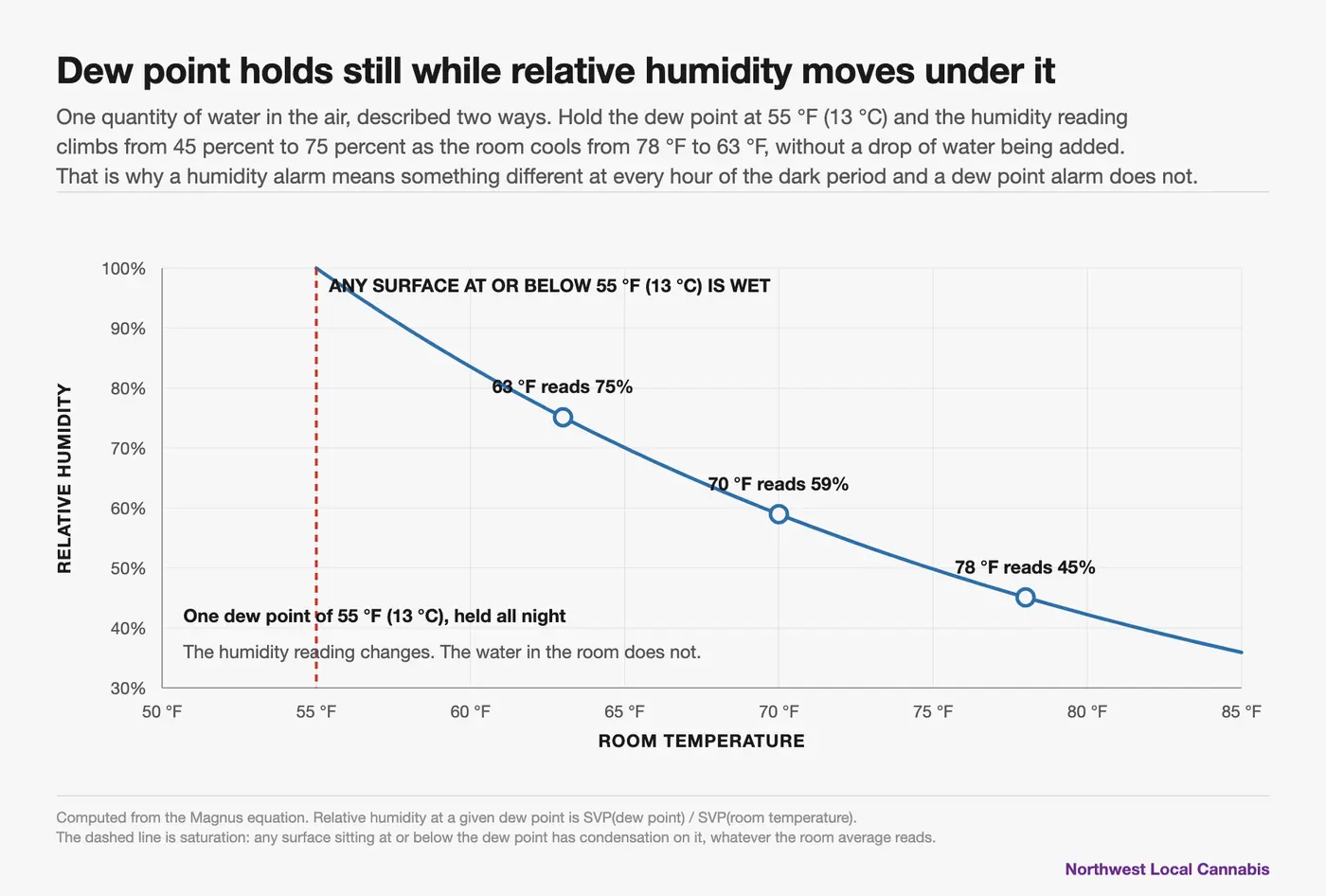
Nothing in the room measures dew point directly. Your controller computes it from a temperature reading and a humidity reading, so it inherits their error, and the error is lopsided: temperature sensors are stable, while capacitive humidity sensors drift fastest after long stretches near saturation, which is exactly what a dark period is. Two points of humidity error moves the computed dew point about 1 °F (0.5 °C), and under-reading is the direction that hurts. Mount at canopy height in moving air, use more than one, and recalibrate on a schedule rather than when a reading looks wrong.
Run 0.4 m/s through the canopy, not across the tops. A leaf in still air is wrapped in a boundary layer Boundary layer The thin film of still, humid air clinging to a leaf surface. Inside a dense cola it never clears, so the tissue sits wetter than the room reading. Moving air strips it away. of its own transpired water, and inside a dense cola Cola A cluster of cannabis flowers packed along a stem. The largest sits at the top of the plant, with smaller ones on lateral branches. Airflow inside a cola is close to zero. that layer never clears, so the tissue sits far wetter than the room reading. Below about 0.3 m/s it does not clear at all; above about 0.5 m/s you are drying tissue and abrading trichomes Trichome The resin gland on cannabis flower where cannabinoids and terpenes are produced. Trichome density is the usual visual proxy for potency. . Buirs, Lung and Punja (2025) reduced bud rot with circulation alone, by lowering humidity inside the inflorescence Inflorescence The botanical term for a flower cluster, what the trade calls a bud. Research reports cannabis yield as inflorescence dry weight. rather than in the room. Measure with a hot-wire anemometer Anemometer An instrument that measures air speed. Hot-wire types resolve the low velocities inside a canopy; vane types stall before reaching them and read zero in a room that is moving air correctly. held inside the canopy at flower height, since a vane meter needs more air than this and reads zero across most of the useful band.
Size dehumidification for the coldest hour, not the daytime setpoint. Holding the taper's final step, a 63 °F (17 °C) room at 58 percent, means the air carries about 62 percent of the moisture that the same room holds in flower at 76 °F (24 °C), and refrigerant dehumidifiers lose capacity as their coils get colder, so demand peaks exactly where the machine weakens. If humidity sits above setpoint while the dehumidifier never cycles off, you are out of capacity, and a lower setpoint will not fix it.
The other cost of a cool night is transpiration Transpiration Water moving up through the plant and evaporating out through the stomata. It drives nutrient uptake, and carries calcium, which moves almost entirely by that flow. . VPD collapses from about 1.23 kPa at the flower night setpoint to 0.82 kPa at the last taper step, even though the humidity reading barely moves. Calcium moves almost entirely by transpirational flow Mass flow The bulk movement of water and dissolved nutrients from substrate to leaf, pulled along by transpiration. Calcium reaches the canopy almost entirely this way. , so a gradient that shallow stops delivering it to developing tissue, and guttation Guttation Droplets a plant pushes out at its leaf margins when root pressure keeps working but transpiration has stalled. Free water sitting on tissue is an infection route. and condensation follow. Whether a cool finish is worth that is a genetics question before it is a climate question, and the evidence is in why cannabis turns purple.
Measure the substrate, not the room. Coco Coco coir A coconut-husk growing substrate. It holds little nutrient charge of its own, so it is fed every irrigation and reacts fast to changes in temperature or EC. below 60 °F (16 °C) slows water and nutrient uptake enough to strand salts, and substrate lags the room, so a 63 °F (17 °C) room through a long dark period is already close to that line. Kim et al. (2025) put peak anthocyanin Anthocyanin Water-soluble flavonoid pigments stored in plant cell vacuoles. They produce purple, red and blue tones in cannabis and in many fruits and vegetables. accumulation at 46 and 59 °F (8 and 15 °C), both below that floor, so the temperature that maximizes color is not a setpoint any coir room can hold.
Why these numbers
The humidity numbers here are not chosen for growth. They are chosen because powdery mildew Powdery mildew A fungal disease that coats leaf and stem surfaces in white powdery growth. Unlike most fungal pathogens it needs no free water to infect, only high humidity. and bud rot are the two failures that take a whole room, and everything else is a smaller loss. Yield decides where you sit inside the safe band. It does not decide where the band is.
| Factor | Botrytis (bud rot) | Powdery mildew |
|---|---|---|
| Favored temperature | 63–75 °F (17–24 °C) | Moderate, with no firm published cannabis figure |
| Favored humidity | Above 70% RH | High humidity, and it needs no free water |
| Your day at 82 °F (28 °C) | Above the window, so the photoperiod protects you | Temperature does not protect you here |
| Your night at 63–76 °F (17–24 °C) | Inside the window on almost every stage | Unchanged, humidity is the only variable |
| Operative control | Humidity ceiling, canopy density, air movement | The humidity ceiling, and nothing else |
| Evidence | Mahmoud et al. 2023, numeric thresholds | Qualitative descriptions only |
Bud rot starts when a botrytis Botrytis cinerea The fungus behind bud rot, also called gray mold. Its spores germinate in prolonged leaf wetness at high humidity, at roughly 55 to 75 °F (13 to 24 °C). spore germinates on the flower, which takes roughly 8 to 12 hours of leaf wetness Leaf wetness Liquid water sitting on plant tissue, from condensation, guttation or irrigation. It is a different measurement from humidity, and several pathogens require it. at 85 to 90 percent RH, at 55 to 75 °F (13 to 24 °C). You cannot outrun it by going colder: every night temperature cold enough to move pigment is inside that window, and the room you would have to drop to in order to clear it is a room that has stopped feeding. There is no colder setpoint that gets you out, only a drier one. Powdery mildew never relaxes at all, which is why the ceiling does not lift during veg.
We treat 65 percent as the ceiling in the dark rather than the 70 percent line the literature draws, and we run six to seven points under it, for two reasons. A wall sensor understates what the flower sees, because inside a dense cola airflow is near zero and transpiration keeps adding moisture. And Buirs, Lung and Punja (2025) found the damaging infections established at flower days 14 to 28 and showed no symptom for weeks afterward, which means the ceiling matters most a month before anyone starts looking for rot.
If you are not enriching
Without supplemental carbon the canopy temperatures in the day table stop making sense, because the whole reason for running hot is that extra carbon suppresses photorespiration Photorespiration A wasteful side reaction in which RuBisCO binds oxygen rather than CO₂, costing energy and releasing carbon the plant had already fixed. It worsens as temperature rises and eases when CO₂ is elevated. . A room held at 85 °F (29 °C) with no gas is paying the photorespiratory cost with nothing offsetting it, which is worse than either setting on its own.
| Setting | Change | Why |
|---|---|---|
| Canopy temperature | Down about 6 °F (3 °C) | Photorespiration is unopposed, so the optimum moves back down |
| Relative humidity | Down 6–8 points | Cooler air holds less moisture at the same VPD |
| Leaf VPD | Unchanged, 1.0–1.4 kPa | The band is chosen for disease risk, which does not care about carbon |
| Dew point setpoint | Down 4–6 °F (2–3 °C) | It tracks the night temperature, which came down with the day |
| Dehumidification load | Up | The plant transpires more without enrichment, not less |
| Taper | Climate taper only | The temperature and humidity taper still runs. What disappears is the injection schedule that used to pull it along, so a cool finish becomes a deliberate decision |
What this does not cover
Drying and curing. Once the plant is cut, VPD stops being the right lens: a drying flower is a water activity and terpene Terpene The volatile aromatic compounds a cannabis plant produces in its trichomes alongside cannabinoids. They account for how a cultivar smells and tastes, and they evaporate readily. retention problem, where the same 60 °F (16 °C) at 60 percent means something entirely different. The clone and veg rows are the thinnest here, because we have not found published cannabis work establishing optimal VPD by growth stage. Those two rows are what we run, not what a paper demonstrated.
Every figure on this page is air temperature, and a transpiring leaf sits below the air around it by an offset that shrinks under enrichment, so measure the canopy with an infrared thermometer rather than trusting a conversion. The humidity ceiling is set by the botrytis literature because that is where the numbers are, which makes it our proxy for a powdery mildew ceiling rather than a measured one. And both Botrytis papers studied greenhouse cannabis: we treat the thresholds as transferable because the pathogen does not know what building it is in, but a sealed room holds conditions far more tightly than the rooms those numbers came from.
References
- Buirs, L., Lung, S., & Punja, Z. K. (2025). The epidemiology and management of Botrytis cinerea causing bud rot on greenhouse cultivated cannabis (Cannabis sativa L.). Canadian Journal of Plant Pathology, 47(5), 443–463. https://doi.org/10.1080/07060661.2025.2478250
- Chandra, S., Lata, H., Khan, I. A., & ElSohly, M. A. (2008). Photosynthetic response of Cannabis sativa L. to variations in photosynthetic photon flux densities, temperature and CO₂ conditions. Physiology and Molecular Biology of Plants, 14(4), 299–306. https://doi.org/10.1007/s12298-008-0027-x
- Kim, S. R., Basnet, P., Kovaleski, A. P., & Ellison, S. L. (2025). Anthocyanin accumulation, inflorescence dry weight and total cannabidiol content have different temperature optima in Cannabis sativa. Journal of Cannabis Research, 7, 51. https://doi.org/10.1186/s42238-025-00311-w
- Mahmoud, M., BenRejeb, I., Punja, Z. K., Buirs, L., & Jabaji, S. (2023). Understanding bud rot development, caused by Botrytis cinerea, on cannabis (Cannabis sativa L.) plants grown under greenhouse conditions [review]. Botany, 101(7), 200–231. https://doi.org/10.1139/cjb-2022-0139
Northwest Local Cannabis publishes cultivation science for licensed producers and home growers. Nothing here is a guarantee of outcome in your room, and setpoints that work in a sealed facility are a starting point for a tent, not a prescription.
Northwest Local Cannabis nw-local.com/blog/dew-point-is-the-setpoint-vpd-by-stage